Old Chart Store
Aktualisiert vor 3 Wochen
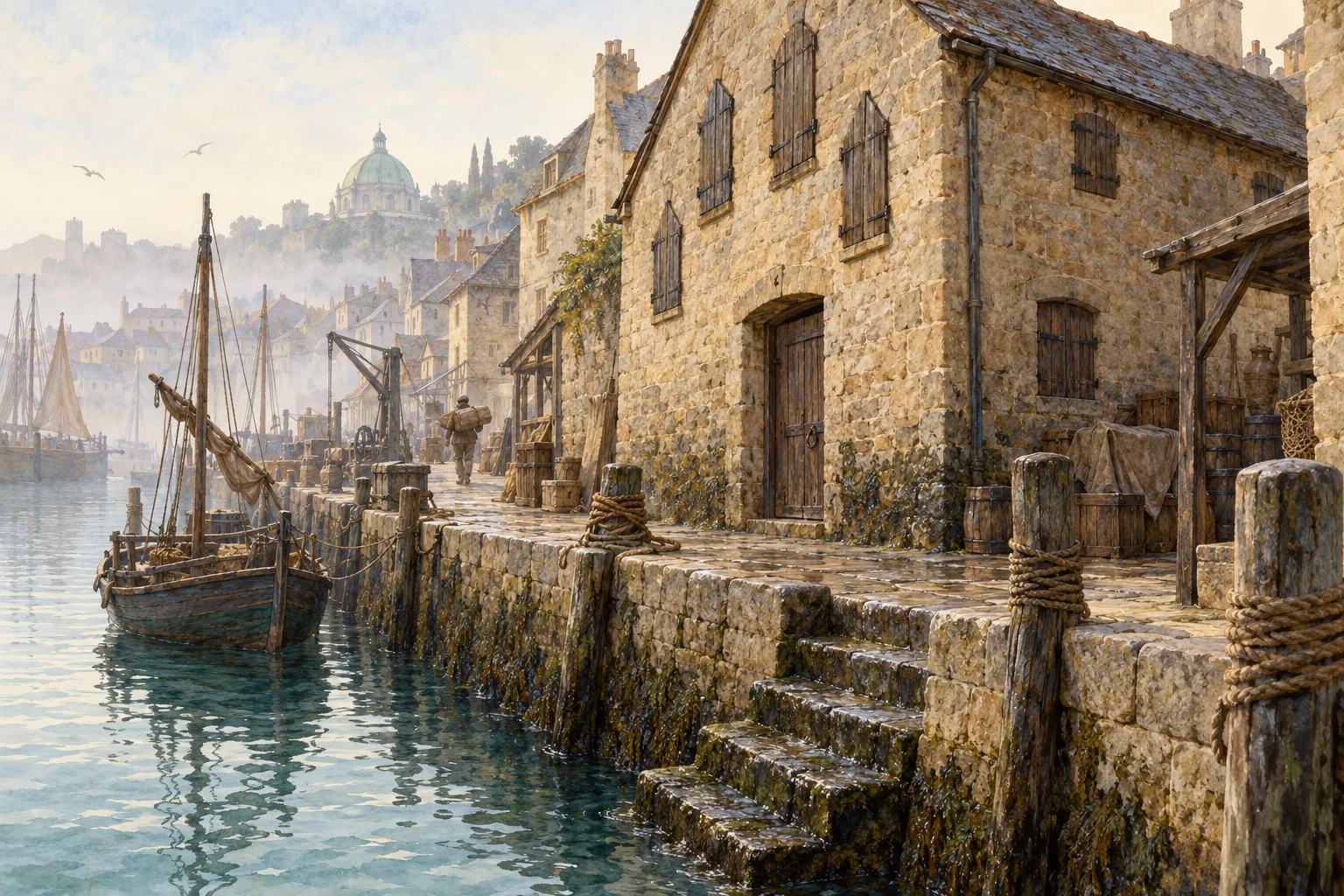
The Old Chart Store is a narrow stone warehouse on Greyharbor's eastern quay. Spray has darkened the lowest stones. The windows sit high, and the entrance is just wide enough to carry a chest through without turning it sideways. Inside, the smell of seaweed gives way to linen, timber and damp paper.
Lio Rask manages the building for the work of the Archive Circle. It is not a public reading room. Sea charts, sealed records and delicate documents wait here for storage, examination or transfer. Questions about ships and cargo usually belong at the nearby Harbor Archive, away from the storage shelves.
A house built against damp
The lowest compartments are raised off the floor. Clean cloths, weights and ties keep an unrolled chart from curling up in every draft. There is little room for two people abreast between the shelves. Visitors must hold their lamps steady, and nobody in a dripping coat may lean over an open sheet.
At the receiving table, an object's identity and condition are recorded before it goes to a shelf. The routine is meant to distinguish storage, use and return. A seal makes unnoticed access harder; it cannot replace a reliable list or establish who entered. Those differences are exactly what make the building interesting to investigate.
The known incident
On 14 Fogmonth 218, Mira Fenn handed the sealed sea chart to Lio here. He accepted it for safekeeping. Later, the group found a broken seal at the store, and the chart was missing. The handover record and the recap describe different moments. Neither records an observed removal.
Access to the building, the condition of the seal and the chart's actual journey are separate questions. A broken seal does not establish a forced door. Proximity to the water does not establish that anyone arrived by boat. Both are possibilities for the group to examine rather than conclusions built into the setting.
Playing here
A careful visit starts with ordinary work: Lio can show the receiving table, Mira can explain her packaging, and the quay makes the possible approaches easier to understand. On the whiteboard, established observations should stay distinct from explanations. Ransacking shelves or opening another seal without permission risks unrelated documents and the Archive's trust.
Even a visit without a new clue can clarify something. A supposedly necessary escape route might be ruled out; two memories might agree only about the order of events. The open quest requires no particular sequence of investigation. The store is the last documented place of custody, rather than a promise that every answer will be found inside.